When the World Feels Angry
A reflection on calm, attention, and community in an age of accelerating change
This morning, I woke intending to write something entirely different. I had planned to continue a reflection on busyness, on the way so many of us move through our days as though pursued by some invisible force that keeps us hurrying onward, often without quite knowing why. But the news has a way of overtaking private intentions. Missiles have been launched. Nations have acted. The Middle East has once again become a place of escalation, and here we are, many hundreds of miles away, watching events unfold with that familiar mixture of sadness, unease and helplessness that comes when something grave is happening beyond our reach.
When the world appears unstable, the instinct is often to answer instability with emotion. Public language begins to harden. Judgements become more immediate. Certainty grows louder. One can feel the temperature rise in conversation, not only in broadcast studios and online commentary, but in cafés, kitchens and all the ordinary places where people try to make sense of events that are far larger than themselves.
Anger travels quickly. It leaps from headline to headline, from screen to speech, from one anxious mind to another. Calm moves more slowly, but where it settles, it brings something that anger rarely allows: proportion, patience and the possibility of understanding.
The Value of Stillness
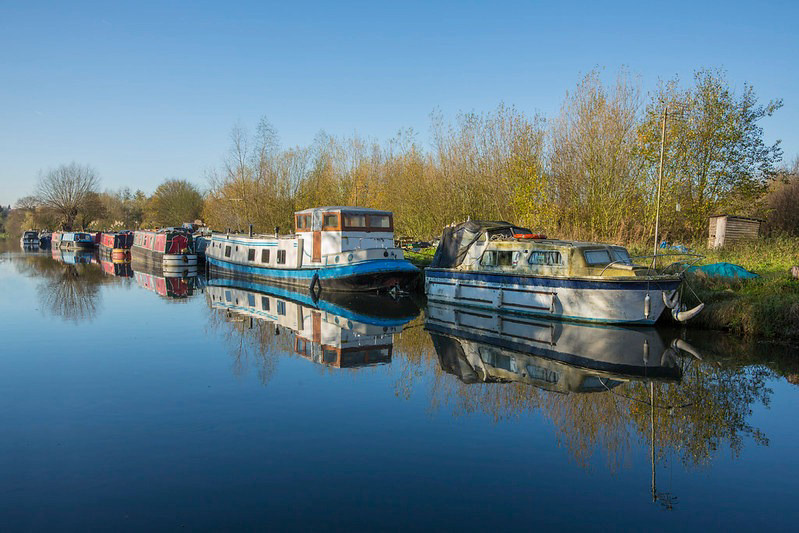
Yesterday I found myself thinking about a photograph I had taken on the River Stort here in Sawbridgeworth. A line of narrowboats rested quietly on still water, the surface so settled that it held the boats and the sky in near-perfect reflection. What stayed with me was not drama but steadiness. Nothing had forced the river into calm. The water had become still because the disturbance had passed. The wind had dropped. Agitation had ceased. In that quiet state, it became reflective in every sense, capable of showing clearly what was there.
There is something instructive in that image. We cannot influence governments' calculations or the movements of armies. We are not seated at negotiating tables. The decisions that shape wars and crises lie far beyond the reach of most ordinary people.
Yet it does not follow that we are powerless. There remains the smaller world immediately around us, and that world is not insignificant. We influence the tone of our conversations. We influence whether patience or hostility enters a room with us. We influence whether we listen with curiosity or simply wait for our turn to speak.
These things may seem small, yet much of the atmosphere of a society is formed in precisely these places.
Attention in a Noisy Age
Ours is an age that encourages reaction. The speed of modern life, and particularly the speed of digital life, makes immediate response feel almost compulsory. We are drawn toward rapid judgment, swift declaration and the constant pressure to take a position.
But understanding rarely arrives at that pace. To understand anything properly—another person, a complex event, even our own motives—requires a capacity to remain still long enough for thought to deepen.
That is one reason photography matters so much to me.
Photography, at its best, asks us to pause. It asks us to look carefully at what is in front of us. In a world shaped by accelerating technology, constant information and endless distraction, the simple act of paying attention has become surprisingly rare.
The camera, used well, becomes an instrument of attention. It allows us to slow down long enough to see what might otherwise pass unnoticed.
Many of the photographs I make grow from that instinct to pause and observe. Beneath them lies a question that feels increasingly important: what does it mean to remain fully human while so many of the conditions around us push toward speed, automation and distraction?
Community and the Human Thread
That question is not only philosophical. It is deeply social.
One of the quieter changes of our time is the way many people have begun to feel detached from one another. A person may be surrounded by information and yet feel starved of understanding. They may be digitally connected and yet profoundly isolated.
We are the descendants of people who survived because they belonged to communities. They knew one another. They depended on one another. Their lives were interwoven.
It may be that in the years ahead, the strength of communities will matter more, not less, precisely because technology is changing so quickly.
This belief sits quietly beneath It Takes A Town. The project was never simply about making portraits. It began with the idea that community is not a slogan but a lived reality. When people stand beside one another, hear one another’s stories and recognise the complexity of another life, it becomes harder to reduce a person to a position or a headline.
Difference does not disappear, nor should it, but it becomes humanised.
Choosing Steadiness
We will not solve international conflicts from Sawbridgeworth. That is not within our gift.
What is within our power is the decision to remain measured when rhetoric rises. We can choose patience where anger might be easier. We can listen more carefully, especially to those with whom we may not agree. We can accept that our own views, however strongly held, may continue to evolve as experience deepens.
The influence of such choices may not be dramatic, but it is real. A calm and respectful exchange can travel further than we imagine. It may leave behind nothing visible except a slight improvement in the atmosphere of the moment, yet those moments accumulate.
When the world feels angry, the most constructive response is often the quietest one: steadiness. Not indifference, but disciplined calm. Not silence born of fear, but speech guided by care.
The river runs whether we notice it or not. On some days, its surface is restless. On others, it becomes still enough to hold the sky. We cannot command the wind, but we can choose how we stand beside the water.
And perhaps that is where meaningful change always begins: not in grand declarations, but in one deliberate act, one thoughtful conversation, one moment in which a person decides that the world does not need more heat from them.
It needs a little more clarity, a little more patience, and a little more of the qualities that make us recognisably human.